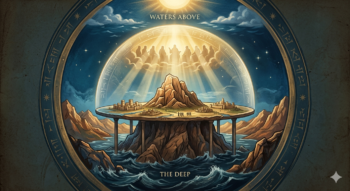
The Axis Mundi of Scripture
Jacob’s Ladder (from Genesis 28) is the biblical vision of a ladder or stairway connecting Earth to Heaven, often interpreted as a cosmic bridge or axis mundi.In the story, the patriarch Jacob (Yaakov), fleeing his brother Esau, stops for the night, rests his head on a stone, and dreams:“And he dreamed, and behold a ladder set up on the earth, and the top of it reached to heaven: and behold the angels of God ascending and descending on it.” (Genesis 28:12)
Other biblical texts build directly on this platform by presenting additional (or climactic) points of contact, mediation, or interchange between the realms. Key examples include: Cosmic mountains as meeting places. Sacred heights repeatedly function as the place where heaven touches earth: Mount Sinai/Horeb — Moses ascends while God descends in fire, cloud, and thunder; the covenant and Torah are given (Exodus 19–24, 34). The mountain becomes a temporary ladder of revelation and presence.
The central TreeThe Tree of Life (and the Tree of the Knowledge of Good and Evil) stands “in the middle of the garden” (Genesis 2:9), serving as a cosmic axis at the center of the created order. Daniel’s vision of a towering tree “at the centre of the earth” whose top reaches the sky (Daniel 4:10–11) expands the same imagery of a world-spanning connector. Early Christian interpretation later identifies the cross as the new Tree that reunites the severed realms.The inverted human attempt: Tower of BabelGenesis 11 shows humanity trying to construct its own “tower with its top in the heavens.” God scatters the builders. The episode underscores that true linkage between heaven and earth is initiated by God (as in Jacob’s dream), not achieved by human ambition—thereby reinforcing the divine character of the ladder motif.
Direct New Testament development
Jesus as the true Ladder — In John 1:51 Jesus tells Nathanael: “you will see heaven opened, and the angels of God ascending and descending upon the Son of Man.”
This is an explicit re-reading of Genesis 28: the connection is no longer a structure but a person. Christ himself becomes the living bridge and the place of reciprocal exchange.
Taken together, these passages develop a consistent trajectory: God repeatedly establishes points of vertical connection—ladder, mountain, tree, temple, and finally a person—so that presence, revelation, blessing, and ultimately full reunion can flow between heaven and earth.
Jacob’s vision is the classic personal instance of a larger biblical architecture that runs from Eden through Sinai and Zion to its fulfillment in Christ and the eschatological city.