Living by Ancient Principles
Ancient wisdom from the Bible can guide us in our daily decisions and interactions. Embracing these principles can lead to a more fulfilling life.
Scientific thinking and traditional religious thinking look at the world in two completely different ways.
1. The “How” Question – The Practical, Material Side.
Modern science focuses on the practical, physical side of reality. It asks: How does this work? What is it made of? What causes what?
Science explains everything using matter, energy, atoms, chemicals, and natural laws.
In this view, the universe runs like a giant machine. Things happen because of blind, mindless forces — gravity pulls things down, electricity flows, chemicals react. There is no deeper “meaning” or purpose built into the system. A rock is just a rock. A star is just a ball of hot gas.
Science is excellent at answering “how” questions and giving us technology, medicine, and useful knowledge.
2. The “Why” Question – The Higher Meaning Side
Traditional religion and ancient worldviews focus on the deeper meaning behind everything.
They ask: Why are we here? What does this mean? What is the purpose? Instead of seeing the world as cold matter and blind forces, religion sees it as full of spiritual truth. Every part of creation — the sky, the sea, animals, humans, even storms and stars — is a sign or reflection of higher spiritual realities.
Events aren’t just random or mechanical; they point to something greater: God’s power, moral lessons, beauty, order, or divine purpose.
In short:
Science is like a mechanic who takes the universe apart to see how the engine works.
Religion is like a poet or priest who looks at the same universe and asks what it means and why it exists at all.
Both perspectives are looking at the same reality, but they focus on completely different aspects — one on the material “how,” and the other on the spiritual “why.”
This is why scientific explanations and religious explanations often feel so different from each other.
Losing the Spiritual View
God told Adam: “Don’t eat fruit from the tree of the knowledge of good and bad. If you do, you will die that day.”
But they ate the fruit anyway. Suddenly their eyes were opened. They realized they were naked, so they sewed fig leaves together to cover themselves. In the end, God sent them out of the beautiful Garden of Eden. They had to leave their easy life and start working hard to grow food from the soil.
Why does this old Bible story still matter?
The Bible’s picture of the world isn’t mainly trying to explain science. It’s trying to explain life at the deepest level — how we think, feel, and find meaning. The story of Adam and Eve eating the fruit is really about what happens when we chase more knowledge. We gain facts about the world, but we can lose our sense of wonder, purpose, and connection to God.
How the Garden story matches what happened after science changed our view of the universe. Imagine the Garden of Eden like this: Humans lived in a simple, protected place.
To truly understand the Bible’s point of view, we need to do something simple:
Pretend for a while that modern science doesn’t exist.
Imagine you have never looked through telescopes or microscopes. Forget about distant stars, galaxies, quasars, atoms, or quarks. Set all of that aside.
Next, step back from the two main ideas we usually have about the universe today:
The heliocentric view (the Sun is at the center)
The geocentric view (the Earth is at the center
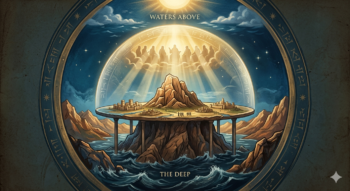
Instead, go even further back in time to the very old way of seeing the world that the Bible uses. This ancient view can be called “tree-centric” (or “dentrocentric”). It places the Tree of Life and the Tree of Knowledge right at the heart of the story. In this picture, the Garden of Eden is the center of human life and meaning.
Why do this?By temporarily stepping into this simple, ancient perspective, we can more easily understand the Bible’s original message and feel its deeper spiritual truth — without modern science getting in the way. It’s like taking off a pair of heavy glasses so you can clearly see an old, beautiful painting the way it was meant to be seen.